Why 471 PDFs Never Clicked
A guided inventory of your own library, the one-page system map, and the vocabulary reconciliation table that explains why modern ICT terms never matched your PDFs.
“I don't have 471 things to learn. I have about 12, and three-quarters of this library is elaboration, commentary, or off-topic for what I trade.”
Start here: nothing is missing from your library
Six years, 471 PDFs, and it never assembled into a system. The usual explanation for that is “you didn’t study hard enough.” That explanation is wrong, and this module exists to replace it with three specific, checkable ones.
- The library presents itself as a flat list. Thirty named objects — order block, breaker, FVG, Judas swing, OTE — arriving in no order, from 471 separate files. A flat list of thirty things is unlearnable. The material contains the structure that organises them; it is on about eight slides out of 1,238, and there is no reason you would have found it.
- Three-quarters of the library is not curriculum. It is commentary, archive, and off-topic-for-forex. Treating all of it as required reading is how you end up permanently in chapter one.
- Your vocabulary and your library are from different eras. This one is the surprise, and it is the subject of the reconciliation table below.
This module fixes all three in about ninety minutes. It teaches no trading concepts at all — it is the map you needed before you opened the first PDF.
1. What you actually own
Every number below was produced by scanning the files on this machine, not recalled from anywhere. Click any figure or quote anywhere in this course and it opens the original PDF at the exact page — check the work whenever you want.
| Collection | Files | Role | What it is for |
|---|---|---|---|
| Forum archive | 358 | Reference | Not curriculum, and never was. Search it when you need a second angle on one idea. Reading it front to back is how a library becomes a wall. |
| ICT Notes (method docs) | 77 | Curriculum | The prose method documents. These are the files with clean text layers, so every definition in this course can be quoted exactly from them. |
| 12-Month Mentorship | 24 | Curriculum | The spine of this course. Taught in a deliberate order, with 1,238 slide pages of annotated chart examples. |
| Third-party books | 8 | Off-curriculum | Not ICT material. Nothing in this course depends on them. |
| 25 Days of Christmas | 3 | Reference | Includes the trade sheet template this course’s journal is modelled on. |
| Market Maker Series | 1 | Reference | Supplementary. The buy/sell model ideas it covers appear inside the mentorship too. |
Counted from the filesystem by scripts/build_sources.py.
Browse and search every one of them at
/reference/sources.
The part that matters: 98 files can be quoted, 372 cannot
Of 470 documents scanned, only 98 have a usable text layer. The other 372 — including most of the mentorship — are images of slides. Their words exist only as pixels.
That is why this course does what it does with figures: every teaching chart you will see is a page rendered out of your own PDF at 150 dpi, captioned with the document and page, and linked back to the source. There are no redrawn charts and no invented examples anywhere in the graded material. When you see an annotation, ICT drew it.
2. The whole system, on one page
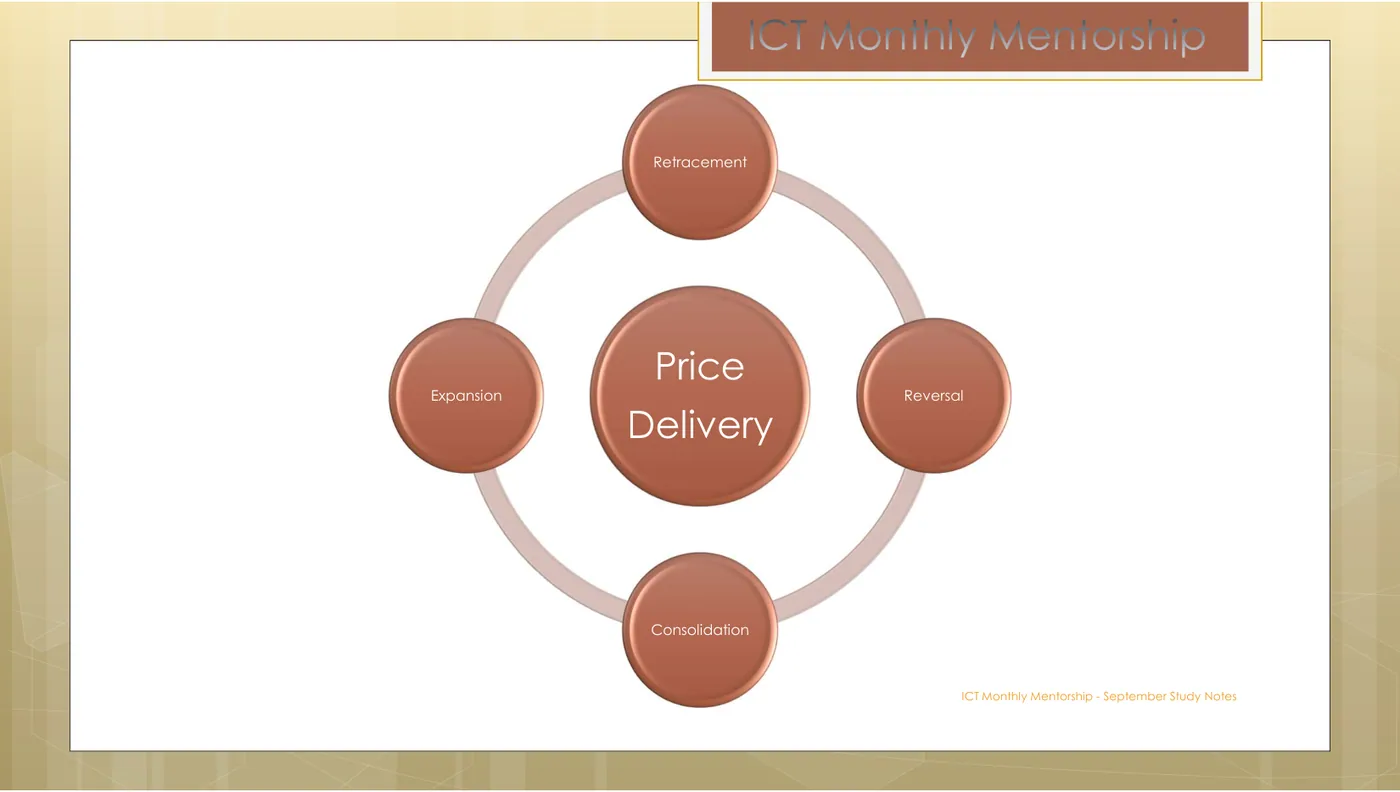
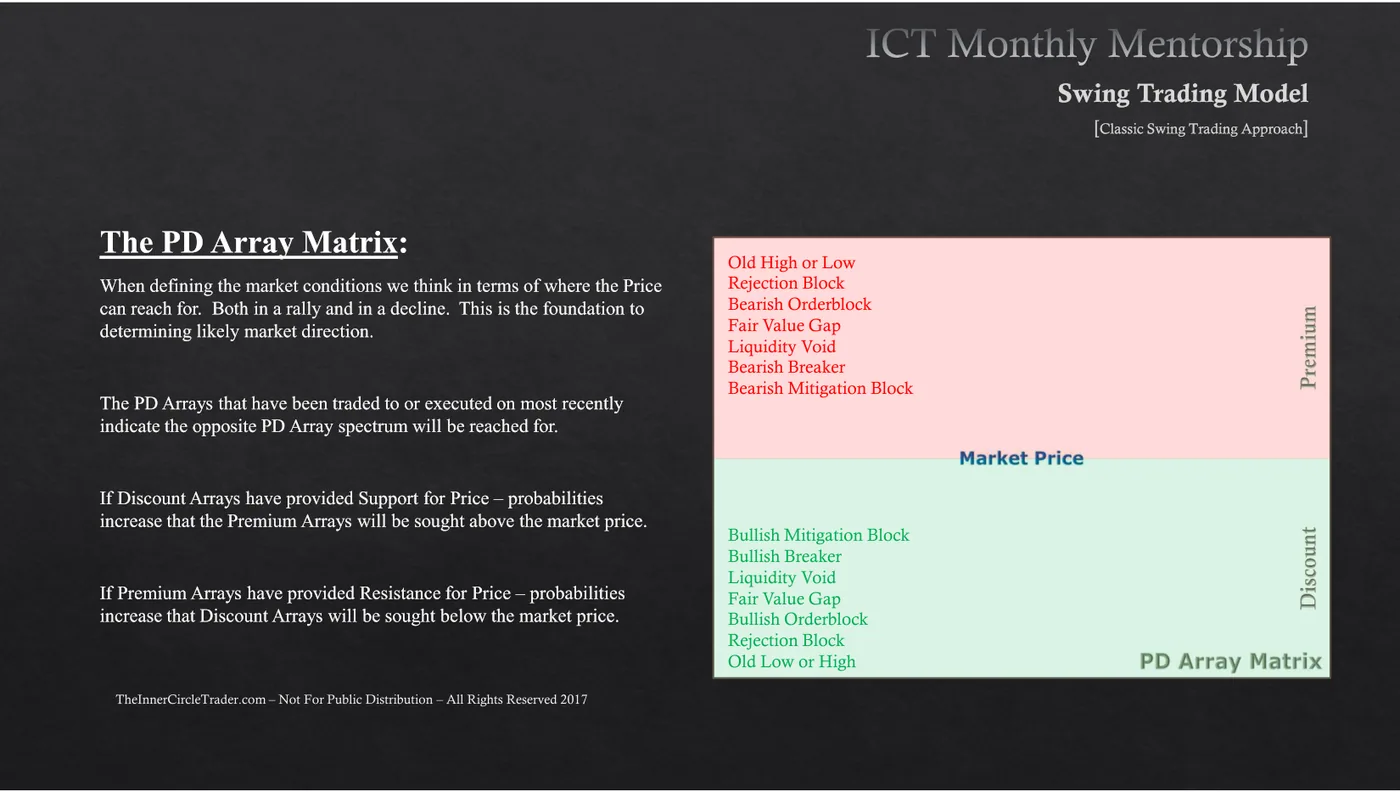
Here is the entire course in two pictures. You are not expected to understand them yet. You are expected to recognise them later and think oh, that’s where this was going.
Picture one — the cycle. Price does four things, forever, in a loop. Each one has exactly one thing you look for. This is Module 1, and it is the single most important page in your library.
Picture two — the ladder. When several levels compete for your attention, this ranks them, and which half of it you are allowed to use is decided by where price sits relative to the middle of the range. This is Module 8, the keystone.
3. Which months matter, and which do not
The mentorship is twelve months. You trade forex. Four of those months are not about forex, and one is not in your archive at all.
| Month | Subject | This course |
|---|---|---|
| 1 | The four-phase cycle, IPDA, liquidity basics | M1, M2, M4 — the foundation |
| 2 | Risk, reward-to-risk, drawdown | M13 — pulled early on the fast lane |
| 3 | — | Missing from your archive. See below |
| 4 | Order blocks, breakers, mitigation, rejection, FVG, ERL/IRL | M2, M5, M6, M7 — the densest month you own |
| 5 | Commodities and seasonal tendencies | Not covered — off-target for forex |
| 6 | The PD Array Matrix; the Swing Trading Model | M8, M14 — the keystone |
| 7 | Time and price; the matrix down the timeframe cascade | M9, M10 |
| 8 | Using the PD Array Matrix with Time & Price Theory | M8, M9 |
| 9 | Open interest, commodity market structure | Not covered |
| 10 | Equities, sector rotation | Not covered |
| 11 | Stock selection | Not covered |
| 12 | The master flowchart; the trade sheet | M10, M14, M15 |
That is the first piece of relief this course can give you: five of the twelve months are not yours to study. They are real content, taught properly, about markets you do not trade. Reading them would cost weeks and change nothing about your EURUSD chart.
4. The vocabulary problem
This is the finding that was not expected, and it may account for more of the last six years than anything else in this module.
Every one of the 470 extracted text layers was searched for the concept terms that circulate in ICT content today. The result splits cleanly in two.
| Modern term | Files | In your library it is… | What to do about it |
|---|---|---|---|
| Displacement | 0 | no equivalent taught in M1 | Not in your material, in any form. The idea it points at — a fast, one-directional move that leaves an inefficiency — is in your library as Expansion (Month 1) and as the Liquidity Void. Note that STRATEGY_DELIVERABLE.md uses "displacement" as a coined mechanical gate (≥1.5×ATR); that is an invention of that document, not a term from this library, and it is labelled as such there and here. |
| Propulsion block | 0 | no equivalent | Not in your material. Do not go looking for it. The nearest concept you own is the order block that price respects a second time — which Month 4 handles under Selecting & Avoiding. |
| Consequent encroachment | 0 | no equivalent taught in M5 | Not in your material. Its 50%-of-the-gap idea is present, though, as the Mean Threshold — Month 4 uses the mean threshold of an order block for exactly this purpose. |
| Silver bullet | 0 | no equivalent taught in M9 | Not in your material at all. It is a post-2022 model. Your library's equivalent slot is the killzone plus the Judas swing. |
| Unicorn model | 0 | no equivalent taught in M7 | Not in your material. It combines a breaker with an FVG — both of which you do own, separately, in Month 4. |
| Phantom divergence | 0 | no equivalent taught in M11 | Not in your material. SMT divergence is, and is covered properly in M11. |
| Inversion FVG | 0 | no equivalent taught in M7 | Not in your material. The nearest owned idea is the breaker: a level that failed and then works from the other side. |
| Liquidity sweep | 0 | Run on a Liquidity Pool / stop run taught in M2 | The phrase "liquidity sweep" does not appear, but the mechanic is defined precisely in Month 4 p.97 as a Run On Liquidity Pool, with a validation condition. Same thing, stricter wording. |
| Imbalance / inefficiency | 6 | Fair Value Gap · Liquidity Void taught in M6 | Your library splits what modern content merges. The FVG is the small one-directional section; the liquidity void is the larger porous range. Month 4 p.86 explicitly links them: an FVG is confirmed by a liquidity void on the lower timeframe. |
| Order block | 20 | Orderblock taught in M5 | Same word, much stricter definition. Month 4 requires a validation event before it is an order block at all. Most of what gets marked online would fail it. |
| Market structure shift (MSS) / BOS | 4 | Market Structure Shift taught in M3 | It exists in your library but is rare and is used loosely — it appears in a handful of files. The rigorous structure tool you own is the short/intermediate/long-term swing hierarchy from ICT Core Concepts. |
| Premium / discount arrays | 17 | PD Array Matrix taught in M8 | This is the part of your library that is *stronger* than most modern material: a ranked ladder, not a loose pair of labels. |
| Breaker block | 4 | Breaker Block taught in M7 | Defined once, exactly, in Month 4 p.53 and p.55 — and with a stated ideal context (major-to-intermediate-term trends) that most retellings drop. |
| Judas swing | 21 | Market Protraction / Judas Swing taught in M9 | Month 1 p.31 gives the current name and the older one in the same paragraph. Well covered in your library. |
| Killzone | 19 | Kill Zone taught in M9 | Fully covered, across 19 files. |
| Vacuum block | 1 | Vacuum Block taught in M6 | Appears in exactly one file. Real, minor, and named once in M6 so it stops being a mystery. |
“Files” is the number of the 470 extracted text layers in which the
term appears at all — case-insensitive, counting a file once no matter how
often it occurs. A zero means the term is not in your material in any form.
Regenerate with python3 scripts/build_vocab.py.
Read the zeroes again. Displacement, propulsion block, consequent encroachment, silver bullet, unicorn model — these appear in your library zero times. Not rarely. Never.
Your library is 2013–2017-era ICT: PD arrays, OTE, killzones, the Asian range, the Judas swing, market maker models, COT and interest-rate triads. The vocabulary that dominates ICT content made after roughly 2022 is a different generation of the same lineage, and it only partly overlaps.
You watch a recent ICT video that builds an entry around a propulsion block. You open your library to find the definition. What is the correct next move?
Which of these are genuine curriculum in your library — material you should study in order, rather than look up? (Select all that apply.)
Modern content calls it a liquidity sweep. Your library never uses that phrase. Does that mean the concept is missing?
5. About a dozen things, not 471
Here is the actual object list. Everything in the mentorship is one of these, an elaboration of one of these, or a chart example of one of these.
Four phases — expansion, retracement, reversal, consolidation. Two locations — premium, discount (and the equilibrium that separates them). Two kinds of liquidity — external (the destination), internal (the route). Seven arrays, ranked — old high/low, rejection block, order block, fair value gap, liquidity void, breaker, mitigation block. One time structure — the weekly profile, the true day, the killzones. One risk rule set — fixed fractional size, 3:1 minimum, hard limits.
That is sixteen objects, and the seven arrays are one object with seven variants. The list fits on an index card. Everything else in 471 files is worked examples of these — which is good, because worked examples are exactly what you need and you have 1,238 pages of them.
Roughly how many distinct objects does this whole method actually contain?
6. How to use this site
Every module has the same four beats. Learn (prose, quotes, figures) → Drill (you commit an answer before you see ICT’s) → Check (concept checks with explanations for every wrong option) → Decision Rule (a card telling you what to do). The cards accumulate; in M14 the plan builder assembles them into your written trading plan.
Two paths. The Fast Lane is the shortest honest route to disciplined demo trading — M0 → M1 → M2 → M4 → M13 → M8 → M9 → M15, about fifteen hours. The full path is all sixteen units. Both are on the path page; either is fine, and the fast lane is the recommended one if you want screen time soon.
Everything is stored in this browser only. No account, no server, nothing leaves the machine. That also means clearing site data deletes your progress — so use the JSON export in settings occasionally. It round-trips cleanly.
Two clicks maximum, always. From anywhere: the one-page reference has the whole system, and the dashboard has the next thing to do. If you are ever lost, one of those two is what you want.
Month 3 of the mentorship is not in your archive. What does this course do about that?
You are keen to trade soon. Which is the honest shortest route through this course?
The decision rule
Every module ends with one of these. They are the only thing in the course you have to be able to execute; the prose exists to make the card make sense.
- When
- You meet an ICT term you cannot define, from a video, a chart, or a thread.
- Then
- Look it up in the glossary first. If it is in your library, learn it from the citation there. If the table says no equivalent, drop it — it is from a different generation of this method and you own no material that defines it.
- Otherwise
- Do nothing with it. An undefined term is not knowledge you are missing; it is noise you have not filtered yet.
Done with M0?
Mark it complete only if you could teach the decision rule to someone else without scrolling back up. Completion is stored in this browser.