Premium, Discount & the Dealing Range
Equilibrium as the 50% of a defined range, and the discipline of defining the range you are measuring before you call anything cheap or expensive.
“Half of my losing trades were buying at a premium. The 50% line would have vetoed them in one second.”
One line, drawn in five seconds, that vetoes half your losing trades
This is the shortest module in Tier 1 and probably the highest-yield one. It teaches a single line — the 50% of a range — and one rule about what you are permitted to do on either side of it.
The reason it matters this much is arithmetic rather than insight. If you buy in the top half of a range, price has to travel further to reach your target and it has less room before it hits your stop. You have taken the same idea and made it a worse trade. Every part of that is fixable by looking at one line before you look for an entry.
Discount and premium, defined
After a market makes a run Higher and begins to retrace lower, look for a drop below 50% of the Price Run Higher. A drop below 50% or Equilibrium indicates that Price is now in a Discount. Frames ideal Buy Setups.
After a market makes a run Lower and begins to retrace higher, look for a rise above 50% of the Price Run Lower. A rise above 50% or Equilibrium indicates that Price is now in a Premium. Frames ideal Sell Setups.
That is the whole concept:
- Below the 50% → discount → you may look for buys.
- Above the 50% → premium → you may look for sells.
- At the 50% → equilibrium → neither.
Read “frames ideal Buy Setups” as a permission, not an instruction. Being in discount does not mean buy. It means that if you were going to buy, this is where you are allowed to. Everything else — is there an array, is there a destination, does it pass the 3:1 filter — still has to be true.
The hard part is not the line — it is the range
Anyone can find the midpoint of two numbers. The skill is choosing the two numbers, and this is where most people using premium/discount go wrong. It is also why M3 came first.
A dealing range runs from a confirmed swing low to a confirmed swing high on the timeframe you are framing on, at the tier you are trading. For your swing default that means the daily chart and the intermediate-term tier.
Three rules that follow from that:
- Both anchors must be confirmed. An intermediate-term high is only confirmed once a lower short-term high has formed on both sides of it. If price is making a new high right now, you do not yet have an anchor — you have an unfinished leg.
- Anchor to structure, never to a calendar window. “The last 30 days” is a number nothing in your material chose. Move it and your equilibrium moves, which flips premium to discount without anything happening on the chart.
- Re-anchor when structure says so, not when price disappoints you. Once a range is broken and a new intermediate swing forms, you have a new range. The forbidden move is redrawing the range because the current one puts your trade in premium.
You want to know whether EURUSD is at a premium. Price is currently printing a new three-month high. Can you answer?
You drew a daily range and price is 15% above the 50%, so your long idea is not permitted. What is legitimate?
What the picture looks like on a real chart
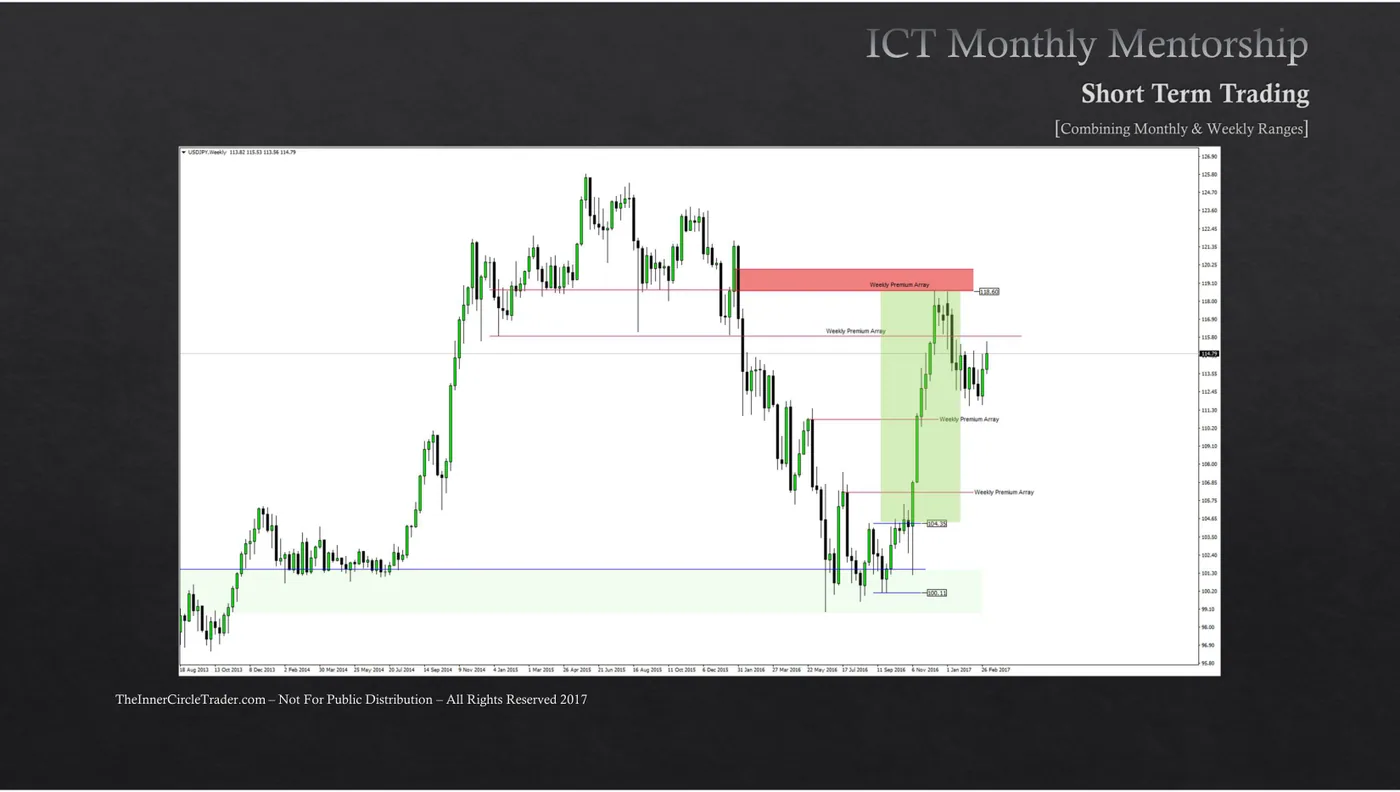
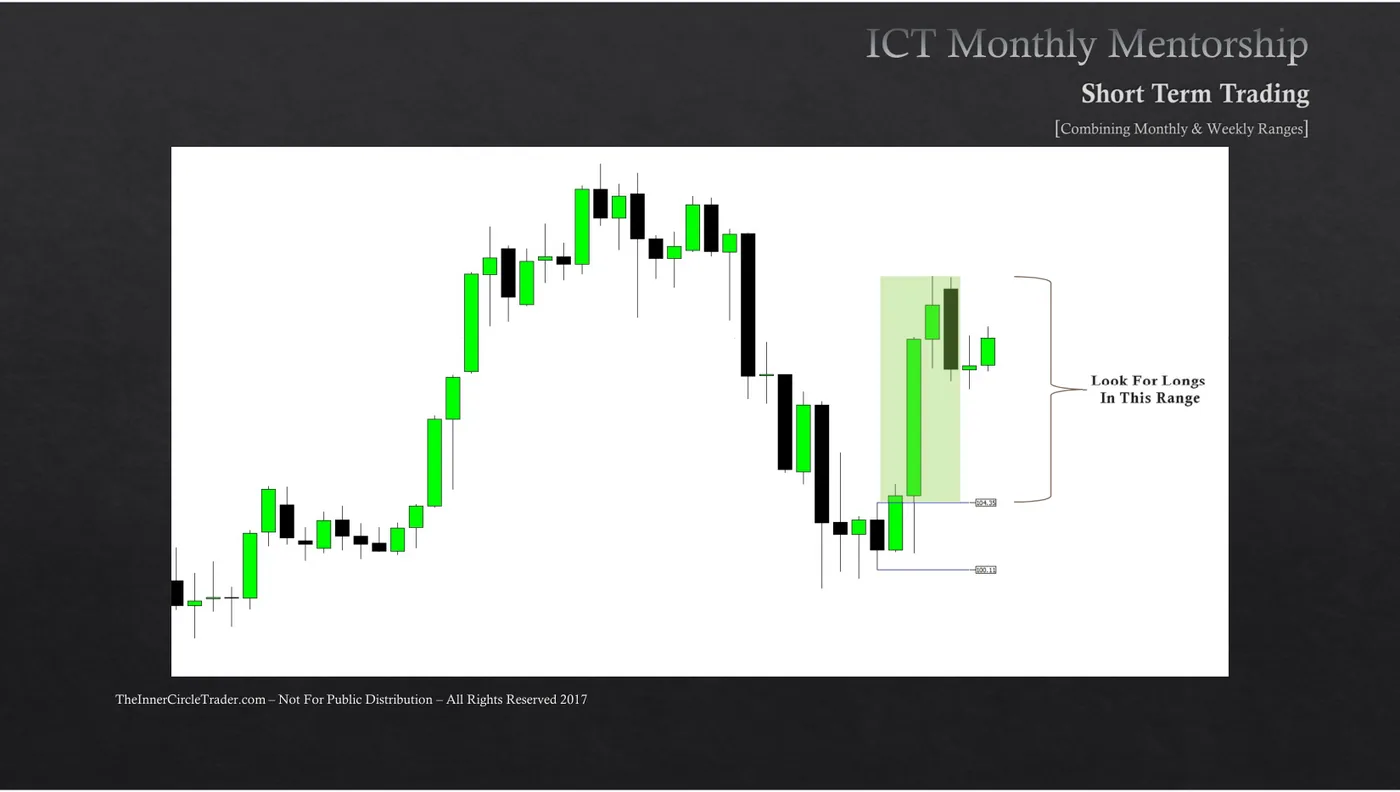
Two details in those slides are worth naming:
Colour is never the only encoding. In his slides and on this site, premium is
always above the market-price line and labelled; discount is always below and
labelled. Position and label carry the meaning. If you prefer, /settings has a
colourblind-safe palette that changes the hues and leaves the layout identical.
“Look for longs in this range” is a search instruction. It narrows where you hunt. It is not a signal, and the slide does not present it as one.
Price is at a discount. What does the rule permit, and what does it not?
Premium and discount nest, exactly like structure
The same price can be at a discount on the weekly and a premium on the 4-hour. That is not a contradiction, for the same reason M3’s tiers were not: they are measurements of different ranges.
Rule of authority, unchanged from M3: the highest of your three timeframes decides. For a swing trade, if the daily range says premium, you are looking for sells — even if the 4-hour retracement you are watching is sitting at a discount of its own little leg.
The 4-hour discount is not irrelevant, though. It is where you enter the daily sell: price rallying into a 4-hour discount that sits inside daily premium is exactly the shape of a swing entry. M10 makes this a procedure; here it is enough to hold that the higher timeframe decides direction and the lower one locates the level.
Daily range: price is in premium. 4-hour range: the recent pullback puts price at a discount of that smaller leg. You swing trade. What is the trade?
Price is sitting within about 2% of the equilibrium of your daily range. What is the output?
Equilibrium is also a destination
One thing that gets missed: the 50% is not only a filter, it is a level price travels to. M1’s consolidation slide already said this — the reference point for the consolidation phase is “the Equilibrium price level that is found exactly in the halfway point of the Consolidation range.”
So the same line does two jobs:
- As a filter: which half am I permitted to trade from?
- As a target: a trade from the extreme of a range has the 50% as an entirely reasonable first objective, and M13’s two-portion exit uses this.
Besides filtering entries, what else is the 50% line used for in your library?
The thirty-second routine
By the end of Tier 1 you have four questions, and they take about half a minute in total on a daily chart:
- Phase? (M1) — expansion, retracement, reversal, consolidation.
- Destination? (M2) — which pool, and is the path clear?
- Range? (M3) — confirmed intermediate swing low to swing high on the daily.
- Half? (M4) — is price above or below the 50%, and therefore what am I permitted to look for?
If any of the four has no clean answer, you are done, and you have spent thirty seconds. That is the whole of Tier 1, and it is enough to eliminate most charts on most days — which is the point.
Run the whole Tier 1 routine. Daily chart: price expanded down out of a range last week, has retraced back up, sits just above the 50% of the completed down-leg, and there are equal lows 60 pips below the range low with clear space in between. What do you have?
Over a week you run the Tier 1 routine on four pairs each morning — twenty reads. On sixteen of them at least one of the four questions has no clean answer. What does that mean?
The decision rule
- When
- You have a bias and a destination, and you are about to look for an entry.
- Then
- Draw the dealing range on your framing timeframe from confirmed intermediate swing low to confirmed intermediate swing high, mark the 50%, and look for entries only in the half that the rule permits: buys in discount, sells in premium.
- Otherwise
- If price is in the wrong half, do not trade — wait for it to come to your half, or drop the idea. If the range cannot be anchored to two confirmed swings, you do not have a range, and the 50% you would draw is a number with no meaning.
Done with M4?
Mark it complete only if you could teach the decision rule to someone else without scrolling back up. Completion is stored in this browser.