Fair Value Gaps & Liquidity Voids
The FVG and the liquidity void, what separates them, and why fair valuation is a profit-taking location as much as an entry.
“The gap isn't a signal. It's unfinished business the market has to come back and settle.”
The retracement phase’s one object
M1 said: when price comes back inside the range it just made, look for the fair value gap or the liquidity void. This module makes that sentence precise. It is also where the course trains its most important skill: answering “there is no gap here.”
The two objects are related but not the same. Mix them up and you will aim at routes and enter at destinations.
The whole idea fits in one line:
The gap is not a signal. It is unfinished business: a stretch of price the market ran through too fast to trade both ways, and typically comes back to settle.
Watch it once before the definitions. Keep an eye on the panel on the right. It shows which side of the market got filled inside the gap: one side on the way up, both sides by the end.
Transcript
- An old high. Buy stops rest above it: the destination.
- Price drops fast, then goes quiet near a low.
- Then it leaves that level fast: one direction, no pullback.
- Inside the fast candle, only buying was offered. Sellers never traded there. (The panel is a schematic, not order-book data.)
- That small one-sided section, marked between the wicks either side of the fast candle, is the fair value gap.
- It is not a signal. It is unfinished business the market tends to settle.
- Zoom out: the whole one-sided run is the liquidity void.
- The gap is a small station inside the void. If you have drawn it as the whole leg, you have drawn a void.
- Price typically comes back to trade the side it skipped.
- ”Typically” is ICT’s word. He gives no frequency and no timetable. It is a tendency.
- In discount (below the range’s equilibrium, its halfway line), the gap is an entry. The stop goes beyond the run that made it.
- The earlier drop left a gap above price. If you are long from below, take profits there. Month 1 calls this fair valuation.
- The rest rides to the pool outside the range. That pool is the reason for the trade.
- Rule: a fair value gap is unfinished business, a station on the route and never the reason for the trade. Small and one-sided means a gap: an entry, or a place to take profits. The whole run means a void: an objective. “No gap here” is a correct answer.
Definition one: the liquidity void
After a sharp run in Price, the large candles that form are the least efficiently trades in the range. Sudden runs in Price will leave porous Price Action that tends to fill in at a later time. This is described as a void of market liquidity or Liquidity Void.
Month 4 restates it structurally, which is the more usable version:
Liquidity Void is a range in Price Delivery where one side of the Market Liquidity is shown in wide or “long” one sided ranges or candles. Price typically will want to revisit this “porous range” or void of contrarian liquidity.
One-sided delivery. Price moved so fast that only one side of the market got filled: buyers on a run up, sellers on a run down. The void is the stretch of chart where the other side never traded. “Porous” means full of holes. “Void of contrarian liquidity” means there were no opposing orders there, and the phrase is precise enough to keep.
Scale: a void is usually several candles. It is the footprint of a whole run.
Definition two: the fair value gap
When Price leave a specific level and only has a small section of price action that is seen as one directional, this is known as a Fair Value Gap. It is very similar to what is traditionally known as a “Common Gap” in technical analysis. They can present objectives for profits or new setups, depending on the current market environment.
The Month 4 restatement contains the sentence that links the two objects:
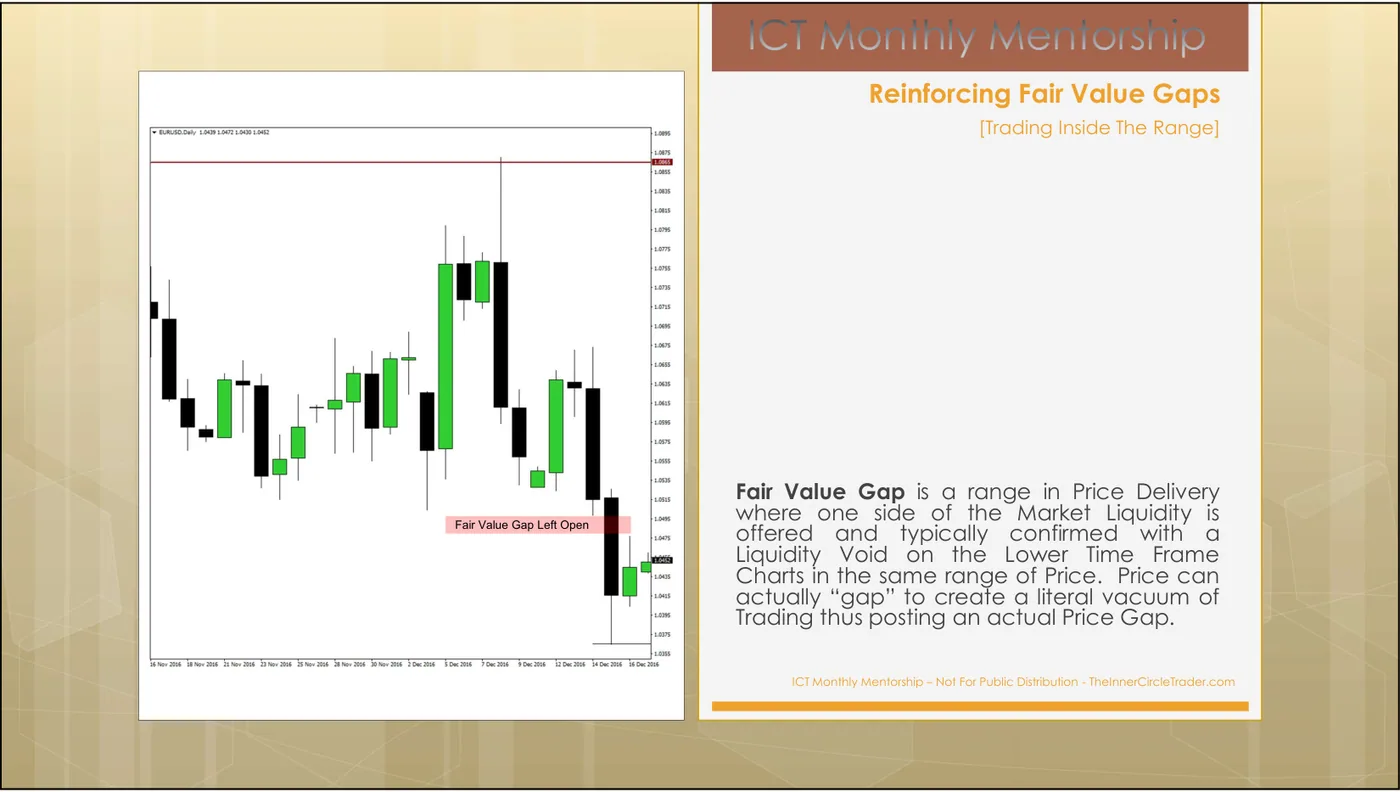
Fair Value Gap is a range in Price Delivery where one side of the Market Liquidity is offered and typically confirmed with a Liquidity Void on the Lower Time Frame Charts in the same range of Price. Price can actually “gap” to create a literal vacuum of Trading thus posting an actual Price Gap.
That is the relationship: a fair value gap on your chart typically shows up as a liquidity void on a lower timeframe, in the same price range. It is the same phenomenon at a different resolution. That is why the two definitions sound so alike: the same thing measured with different rulers.
| Fair value gap | Liquidity void | |
|---|---|---|
| Size | A small section, usually a few candles | A wide range, the footprint of a whole run |
| On your chart | A small box inside a fast leg | Most or all of the fast leg |
| On a lower timeframe | Typically shows up as a void | Contains fair value gaps |
| Used for | Entry, or an objective | Mostly an objective; the midpoint is a common reaction area |
What exactly is the relationship between a fair value gap and a liquidity void?
Where you actually see one
Month 4 asks the question on one slide and answers it on the next. The drills below walk through that sequence. It is the closest thing to an author-written quiz in your library.
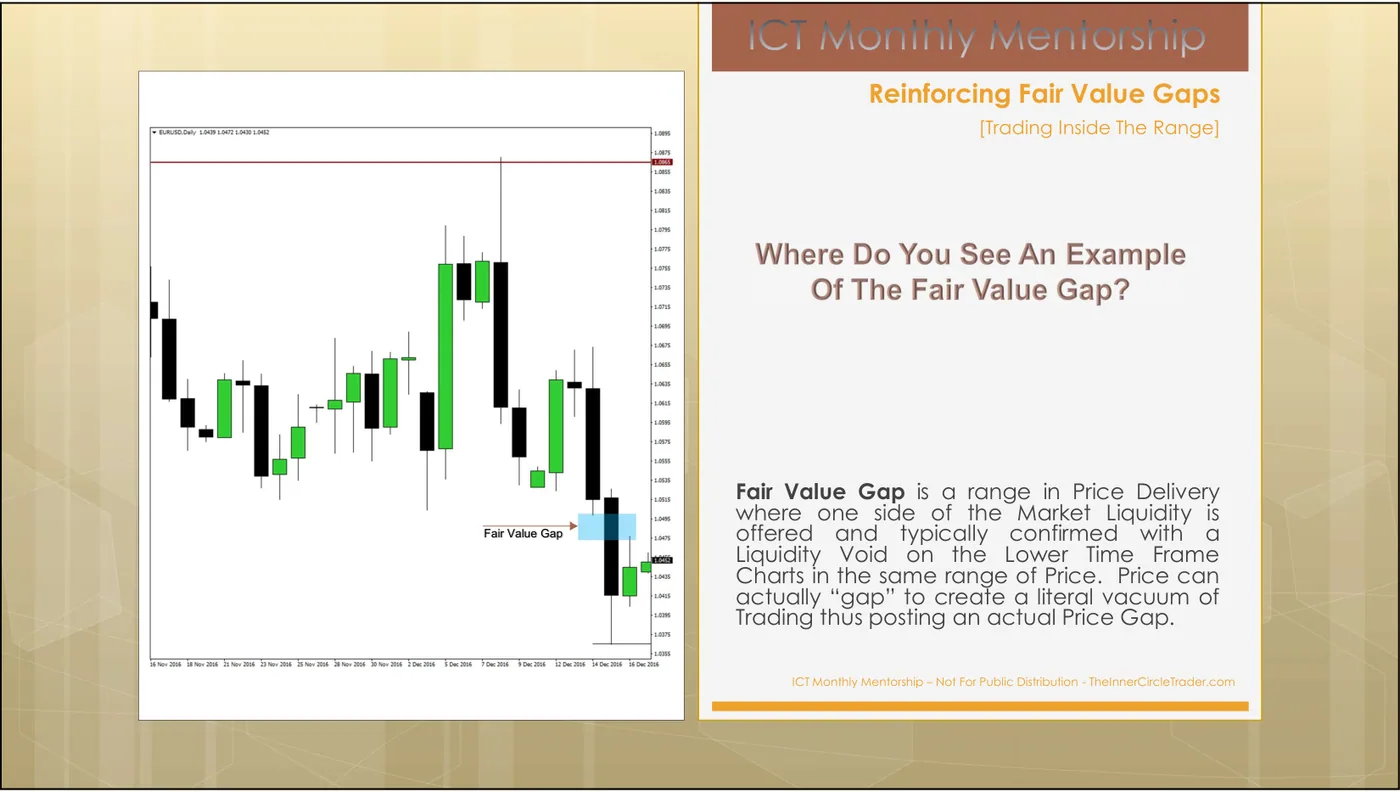
Note how small it is. The most common mistake in practice is drawing a fair value gap the size of the whole impulse leg. A gap that big is a liquidity void, and it does a different job.
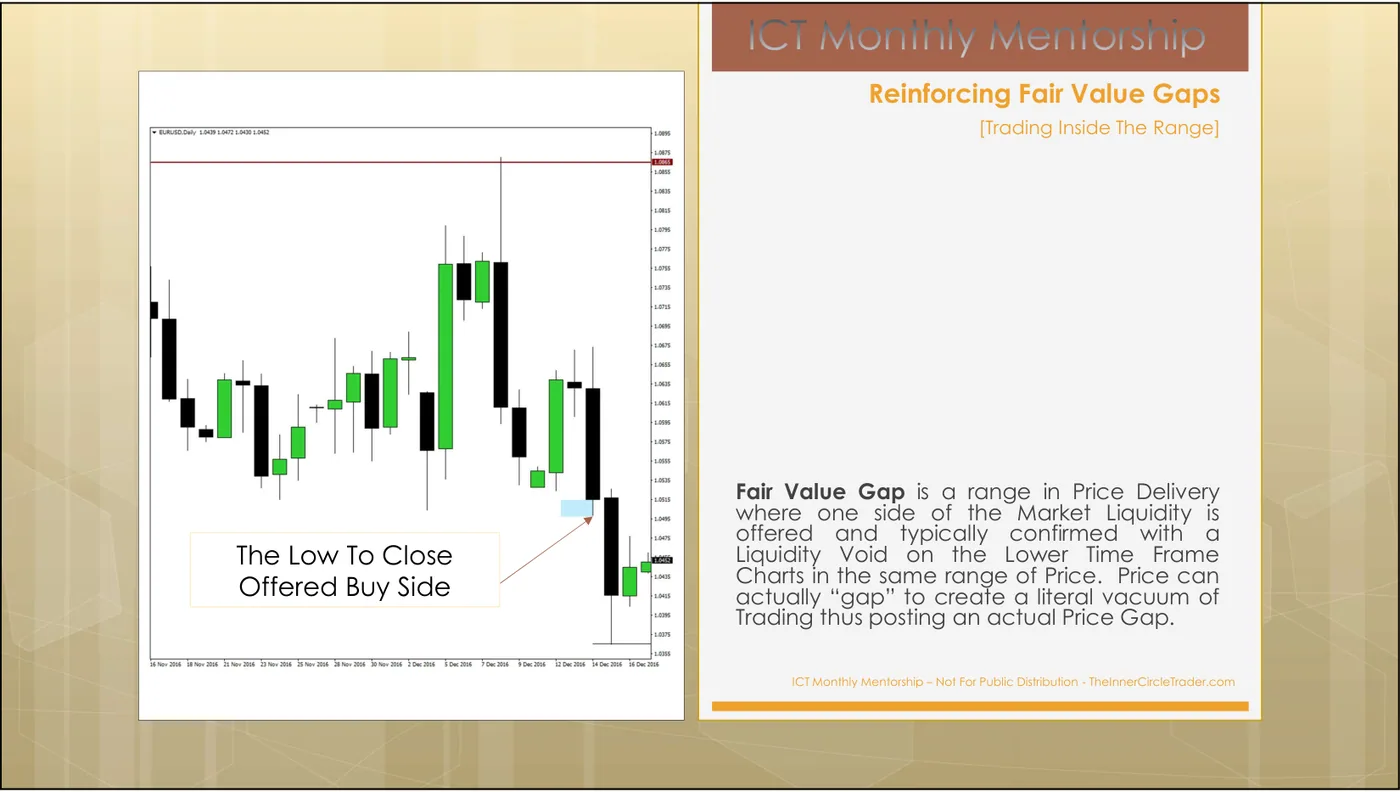
ICT asks this question on his own slide: where do you see an example of the fair value gap? The definition is beside the chart. Commit to a specific location before revealing — this is his answer key, not one written for you.
The gap is marked. Before revealing: describe in words what is being measured — which side of the market was offered, and between which two points on the chart?
Unfinished business, not a signal
Price typically will want to revisit this “porous range” or void of contrarian liquidity.
The word is typically, not always. Your library does not claim that gaps fill. It claims price tends to revisit ranges it moved through one-sidedly, and it explains why: the side that was skipped has not traded there yet.
This matters because a lot of people use “gaps get filled” as a trade idea, and it is not one. It describes a tendency with no timeframe attached. Held as a trade thesis, it produces the worst kind of loss, the one you keep holding because the gap is still open and so you are still “right”.
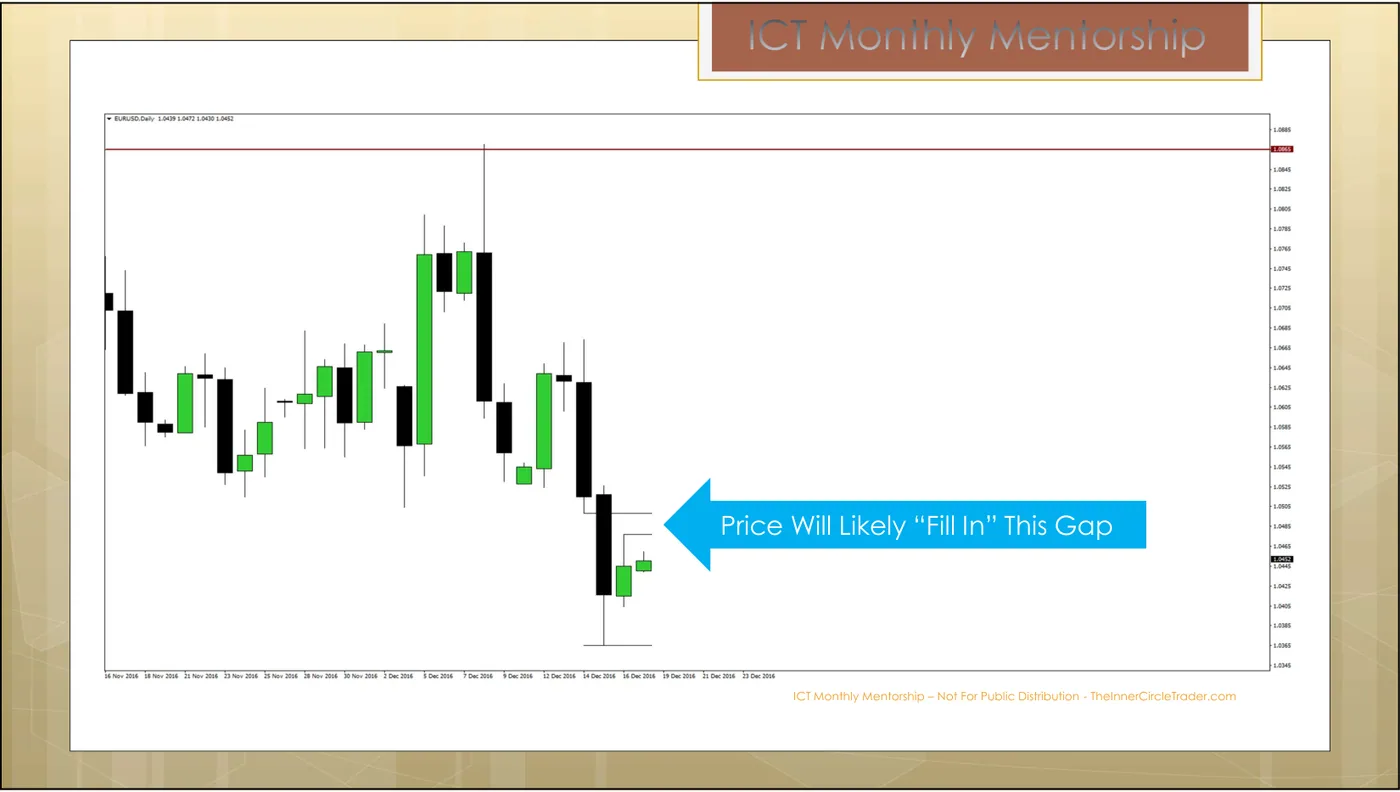
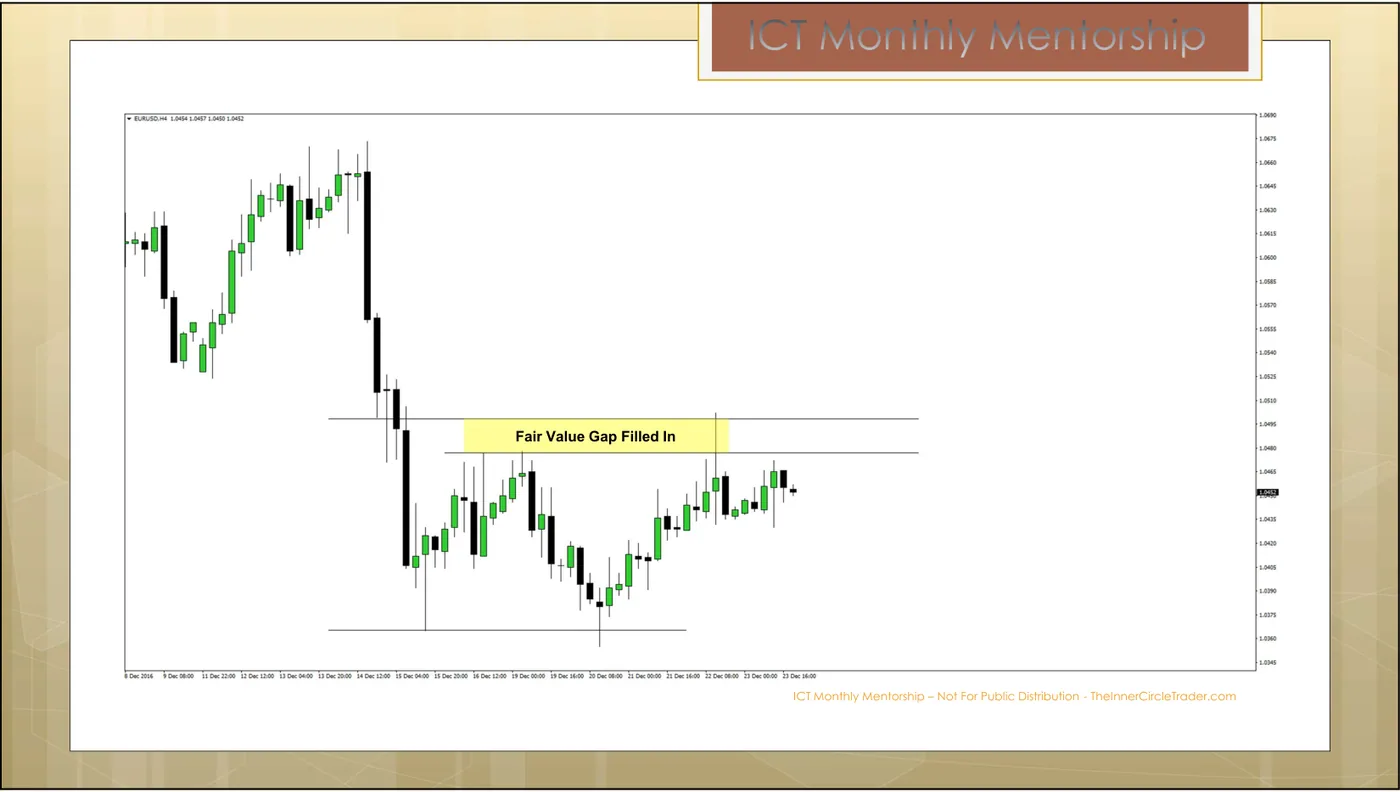
Once a gap has been filled, it has done its job. Take it off the chart. A screen full of old filled gaps is a screen full of levels that no longer mean anything.
A gap has been left open. Before revealing: state what you would use it for — entry, objective, or nothing — and what would have to be true for each.
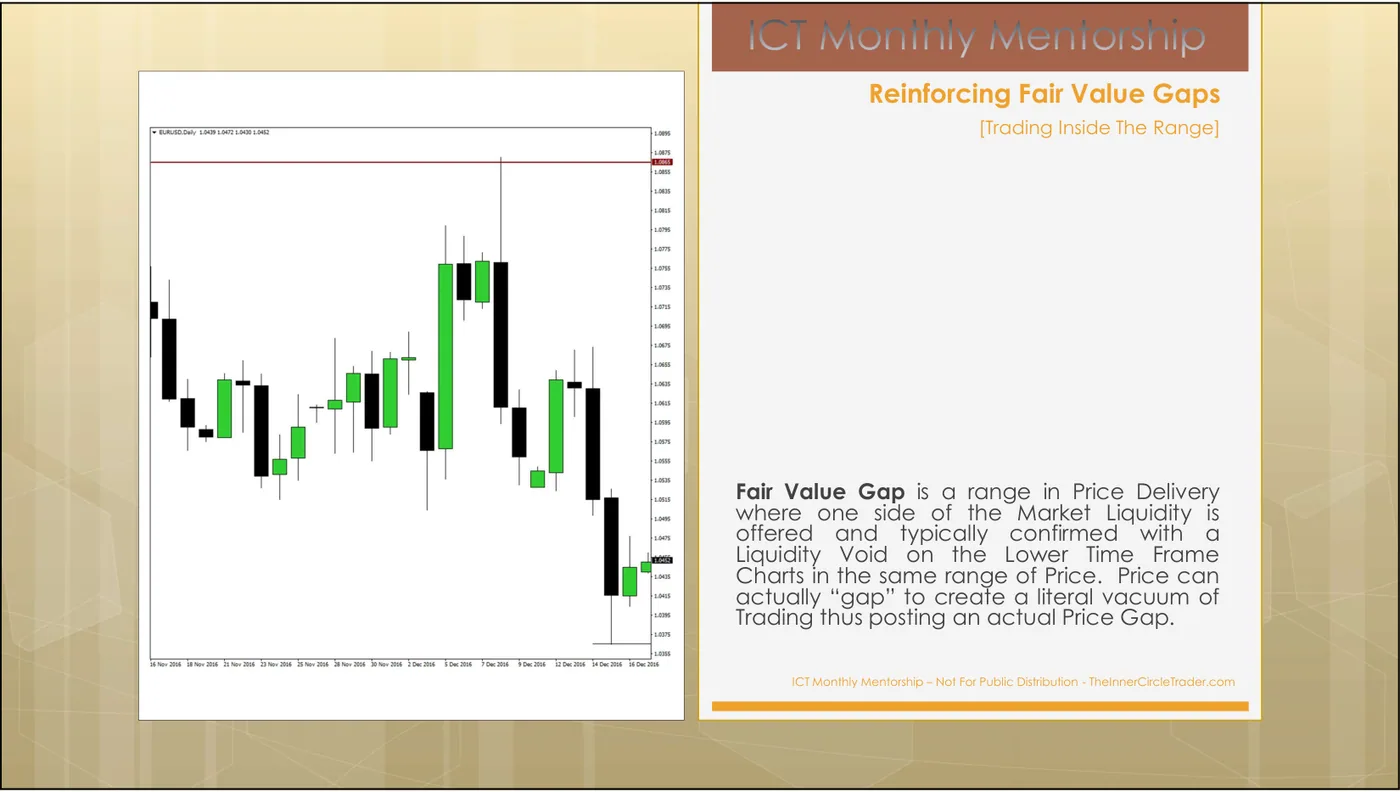
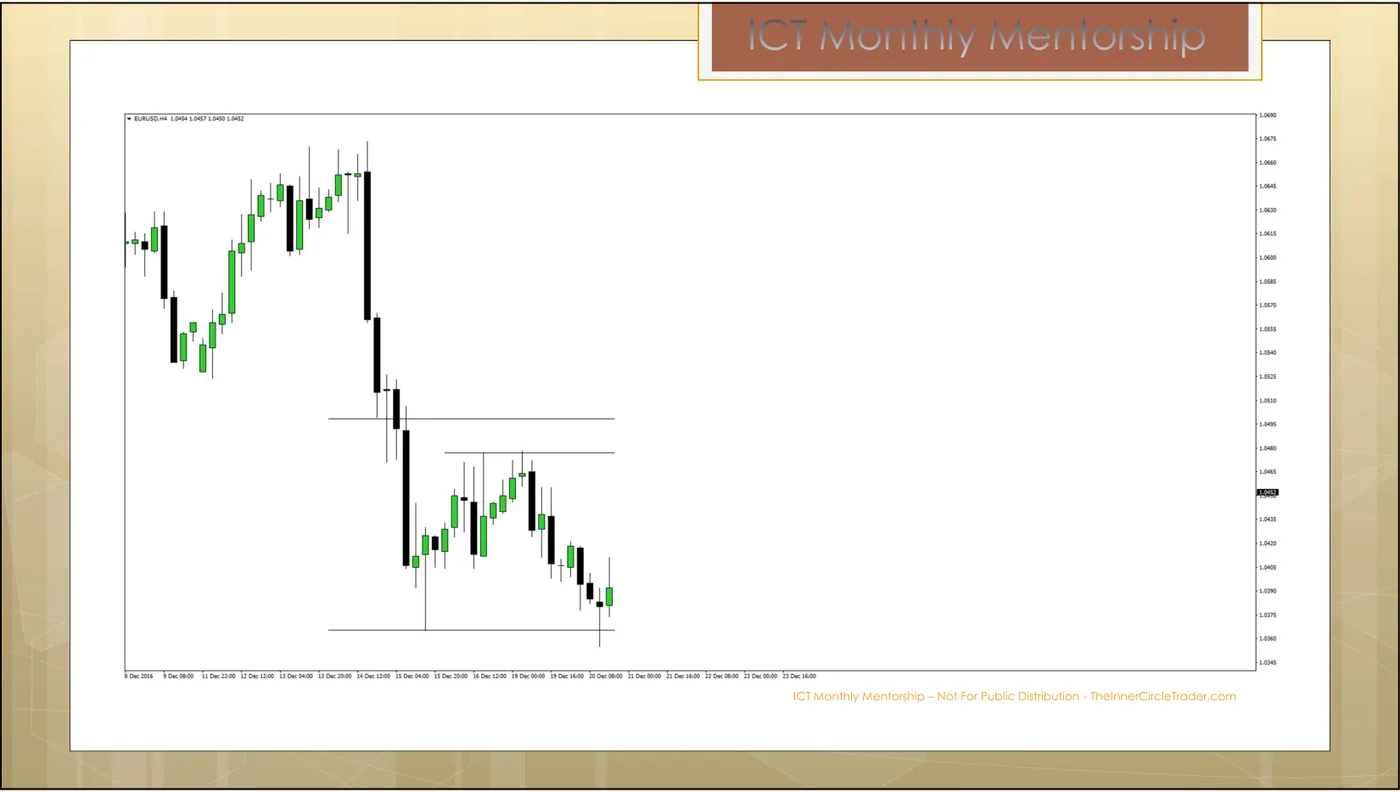
A clean chart. Before revealing: find the fair value gap left by the decline, and say where price would have to trade for it to be considered filled.
Fair valuation: the gap is also an exit
This is the part almost everyone drops. Month 1 has a separate slide for what happens when price returns to where it came from.
When Price trades back inside it’s current range and returns to the levels it recently moved from, this is Fair Valuation. Smart Money will unload long positions in this area and many times establish new shorts. Good location to take profits on a long position and not require a move outside the current trading range.
Read the last sentence twice: “Good location to take profits… and not require a move outside the current trading range.”
If you tend to hold for the big target and watch winners come back, this sentence is for you. It gives you a legitimate objective inside the range, one that does not need the market to do anything dramatic. The last scene of the explainer shows it: the long from the lower gap takes profits in the gap the earlier drop left above. M13’s two-portion exit is built on this. Take a portion at fair valuation and carry the rest to external liquidity.
You are long from a discount array. Price rallies back to the area it recently sold off from. Month 1 calls this Fair Valuation. What does the slide actually recommend?
The gap as internal range liquidity
Put it into M2’s frame and the ambiguity goes away:
- A fair value gap is internal range liquidity, meaning it sits inside the current range. It is a station.
- Old highs and lows are external range liquidity, the stops resting outside the range. They are the destination.
So the gap can be:
- an entry: price retraces into it and you get filled on the way to something outside the range;
- a partial objective: you are long from below, and the gap above is where you take something off.
It is never the reason for the trade. The reason is always the pool outside the range.
Where does a fair value gap sit in M2's external/internal split, and what follows?
“None” is the skill
Here is the honest part of this module.
Fair value gaps are the easiest object in this method to see where none exists. The criterion, “a small section of price action that is seen as one directional”, is the loosest definition in your library. Put a loose criterion together with a trader looking for a reason, and you get a gap on every chart.
The skill that keeps you solvent is not finding gaps. It is declining to find one. That is why marking drills in this course have “none” as a correct answer, scored the same as any other.
A workable strictness test, built from the two definitions:
- Is the section genuinely one-directional, with no meaningful two-way trade inside it? (Overlapping wicks mean both sides traded.)
- Is it small compared with the leg? If it is most of the leg, you are looking at a liquidity void. Use it as an objective, not an entry.
- Did price leave a specific level to create it? A gap in the middle of a slow drift is not the object the definition describes.
- Is it in the half of the range you are allowed to trade from, on the way to a named destination?
If any answer is no, the answer to “is there a gap here?” is no.
You are looking at a 4-hour chart during a slow two-day drift lower. Small one-candle imbalances appear all over it. Is there a fair value gap you should trade?
Your candidate 'fair value gap' spans about 70% of the impulse leg that created it. What is it, and what should you do with it?
One more object, named once and dropped
Bullish Vacuum Block is a “gap” created in Price Action as a result of a volatility event. The gap forms by a “vacuum” of liquidity directly related to an event. NFP [Nonfarm Payroll] can create a Vacuum Block or in futures a session opening can.
A news gap. It appears in exactly one file in your library, so the course names it, tells you it is real, and moves on. A violent gap around a data release has a name now. Your material has nothing more to teach about it, and going to look for more is the loop M0 warned you about.
The vacuum block appears in exactly one document in your entire library. How should the course treat it, and what does that tell you generally?
The decision rule
- When
- Price is retracing (DR-1) inside a range you have anchored (DR-3), in the half you are permitted to trade (DR-4), toward a destination you have named (DR-2).
- Then
- Look for a fair value gap in the permitted half and treat it as an entry; treat any gap or void on the far side of price as a possible partial objective. Enter at the gap, define risk beyond the array that created it, and target the external pool.
- Otherwise
- If the candidate gap is most of the leg, it is a void — use it as an objective, not an entry. If the section is not clearly one-directional, there is no gap. Answering “none” is a correct, complete result and costs nothing.
Done with M6?
Mark it complete only if you could teach the decision rule to someone else without scrolling back up. Completion is stored in this browser.